
Grand County Criminal History Checks
Start by deciding which record can answer the question. A recent incident report belongs with the agency that wrote it. A jail booking belongs with the Grand County Sheriff Records Division. Filed charges and outcomes belong with Grand County Combined Courts. A statewide self-review belongs with the Colorado Bureau of Investigation. Searchers should collect a full legal name, date of birth, spelling variants, the event date, and any case or citation number before making a request.
The strongest check compares sources. A booking charge may change before a prosecutor files the court case, and the final disposition may reach the state repository later. Grand County has no official public jail roster, so current custody questions require a call to the jail. Court hearing information can be checked online, but documents and the register of action must come from the clerk.
- Identify the arresting agency and whether the question concerns an incident, custody, a court case, or statewide history.
- Use the sheriff form for sheriff and jail records, or the state docket for a scheduled Grand County hearing.
- Match results with a birth date and case details, not a name alone.
- Ask the court clerk for the register of action and disposition when a case result matters.
- Order a CBI self-check and challenge errors through CBI when the statewide record is incomplete.
The official Grand County portal is the safest starting point when an office link or contact has changed.
Its department directory separates sheriff, court, and county administrative functions before a request is sent.
Grand County's Two-Office Trap
Criminal records are split across two nearby addresses in Hot Sulphur Springs. Grand County Combined Courts at 307 Moffat Avenue holds criminal court files. County administration and the sheriff's records counter are at 308 Byers Avenue. The elected County Clerk and Recorder handles land, vehicle, election, and vital records, not criminal cases. Asking for a criminal docket at the county recorder sends the request to the wrong custodian.
The county court contact page shows the justice offices located in this compact center. The page below preserves that official contact view.
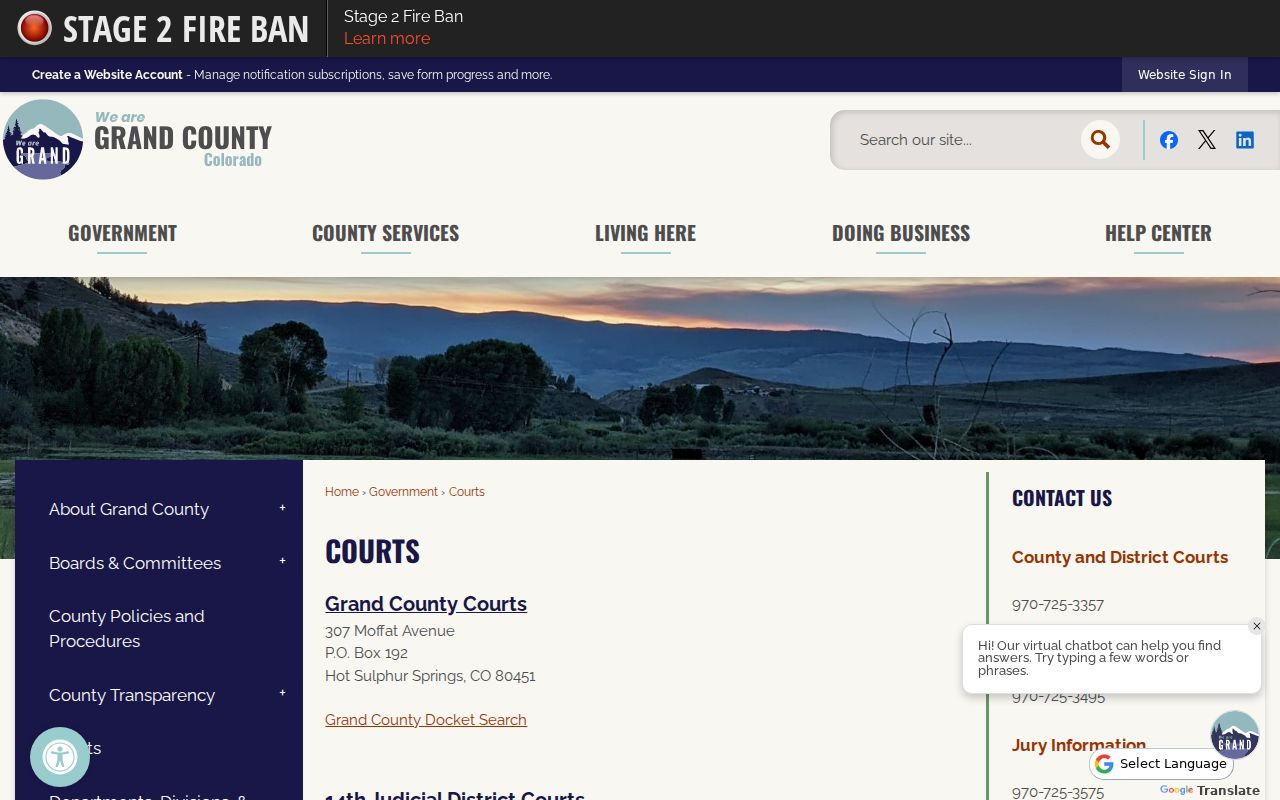
Use the judicial clerk for charges, orders, sentences, and certified copies. Use Sheriff Records for incident, arrest, booking, and jail material.
Official Background Checks in Colorado
The Colorado Bureau of Investigation, Biometric Identification and Records Unit, maintains Colorado Criminal History Record Information in CCIC. Any member of the public may use the Internet Criminal History Check for a Colorado-only name search. The current fee is $6 for each downloaded result, and several possible matches can produce several charges. The result cannot be notarized and is not a national check.
Colorado Applicant Background Services, or CABS, is the fingerprint channel. CBI lists a $16.50 state component for an individual Colorado fingerprint history; vendor capture costs and any authorized FBI component are separate. For personal federal history, the FBI Identity History Summary process is the direct source.
| Channel | Best use | Limit |
|---|---|---|
| CBI ICHC | Colorado name search | Name matches can be uncertain |
| CABS | Fingerprint-linked Colorado record | Appointment and vendor fee apply |
| County court clerk | Filed case and disposition | One court file at a time |
The CBI records overview explains the official choices.
CBI supplies the statewide layer, while Grand County agencies supply the local file behind an entry.
Grand County ICHC Name Matching
A name search works best with the exact first, middle, and last name plus a date of birth. A Social Security number is not required for a public ICHC name check. Common names can return more than one candidate, and each downloaded result has its own fee. Review identifying details with care before treating a candidate as the right person.
The official ICHC interface is the operational entry point.
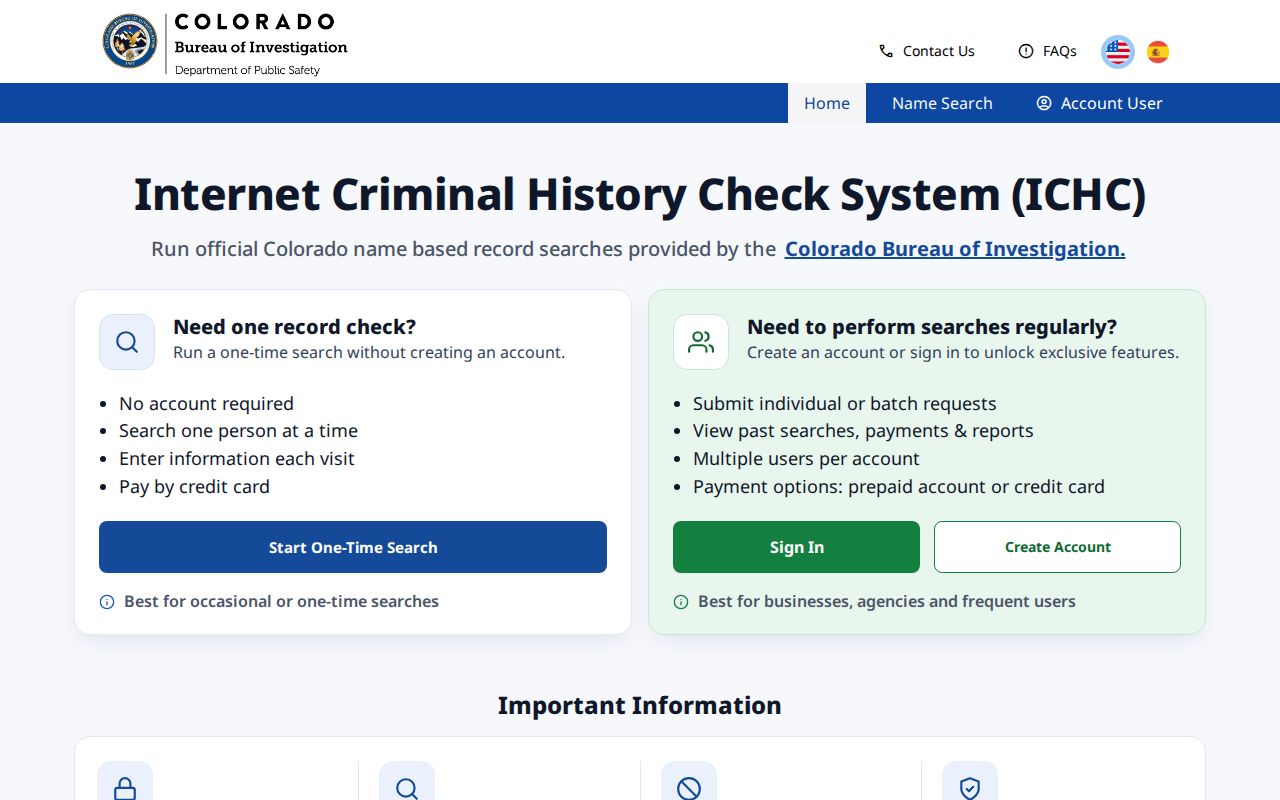
Public output omits sealed arrests, most juvenile arrests, and certain traffic arrests from before age sixteen. A missing item can reflect a lawful exclusion or a reporting gap.
Kinds of Criminal Records
Each stage creates its own record. Police and deputies write incident and arrest reports. Detention staff add booking, bond, property, and custody entries. Prosecutors choose filed charges. Courts record hearings, pleas, rulings, dispositions, and sentences. CBI links reported arrests and dispositions to a state identity record, while CDOC tracks state prison and some community-supervision status.
- Incident and arrest reports: held by the agency that created them.
- Booking records: held by Grand County Jail and Sheriff Records.
- Court files: held by the judicial clerk or municipal court.
- State history: maintained by CBI from fingerprint and disposition reports.
- Custody and supervision: divided among the jail, judicial probation, CDOC, and parole.
Grand County Jail Without a Roster
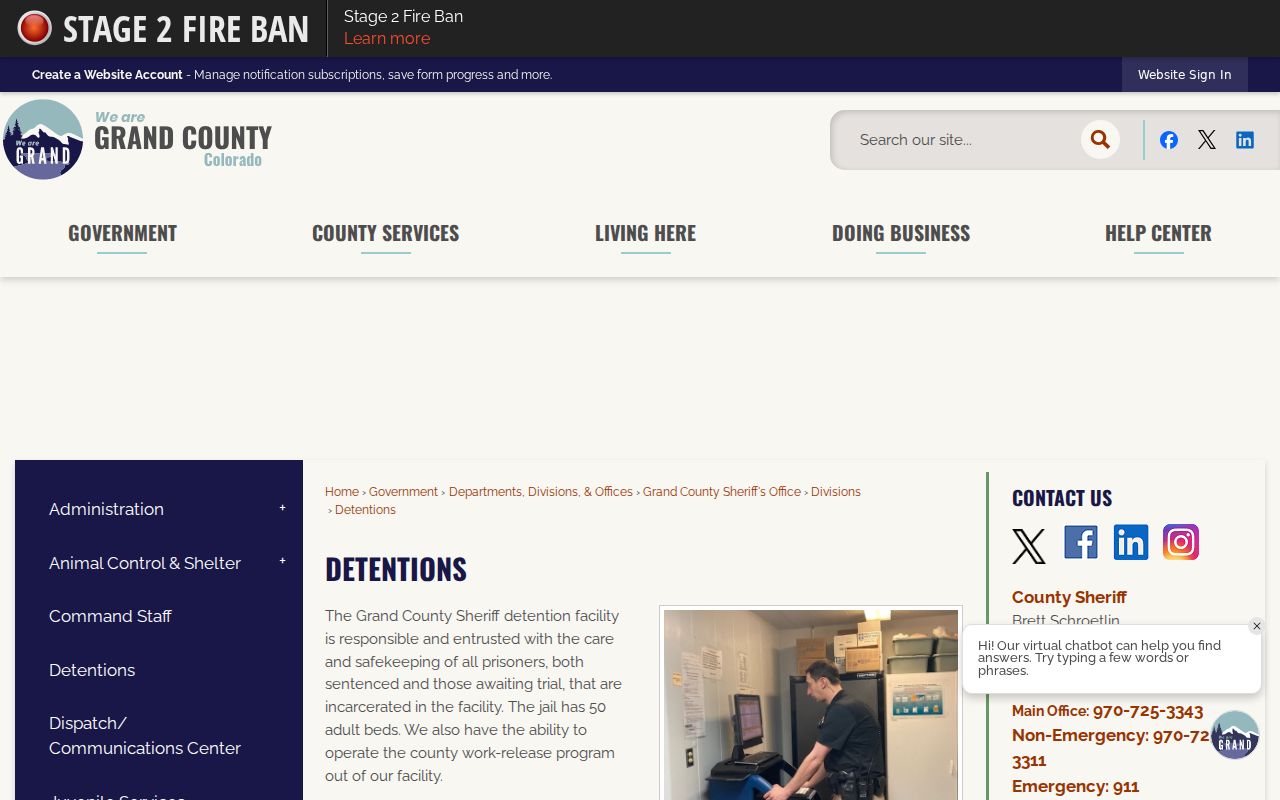
Grand County Jail has 50 adult beds and houses both sentenced people and those awaiting trial. The county did not publish an official online inmate roster in the researched channels. For current custody, bond, or visitation questions, call 970-725-3343 and select extension 3 for a detention deputy. For a copy of the booking record, submit the sheriff's criminal-justice-record request instead.
The official Detentions page is the county source for jail contacts and rules.
CDOC Offender Search is a separate tool. It covers state custody and some supervision states, not a person held only in the county jail.
Grand County Criminal Records: What They Contain
A complete record can identify the person, arrest cycle, filed case, and final result. Yet each source shows only its own part. The court register of action is often the clearest place to confirm whether a charge was dismissed, reduced, resolved by plea, or tried. CBI gives a narrower statewide summary, and the jail answers custody rather than guilt.
| Name & Identifiers | Legal name, aliases, birth data, and agency identifiers where releasable. |
|---|---|
| Arrest / Booking Data | Arrest date, agency, alleged charge, booking event, and bond information. |
| Charges & Statutes | The prosecutor-filed counts and cited Colorado law. |
| Disposition | Dismissal, acquittal, plea, conviction, deferred result, or other final action. |
| Sentence | Custody, fine, probation, or other terms ordered by the court. |
| Custody / Supervision | County jail, state custody, probation, or parole status where public. |
Grand County Sheriff Record Requests
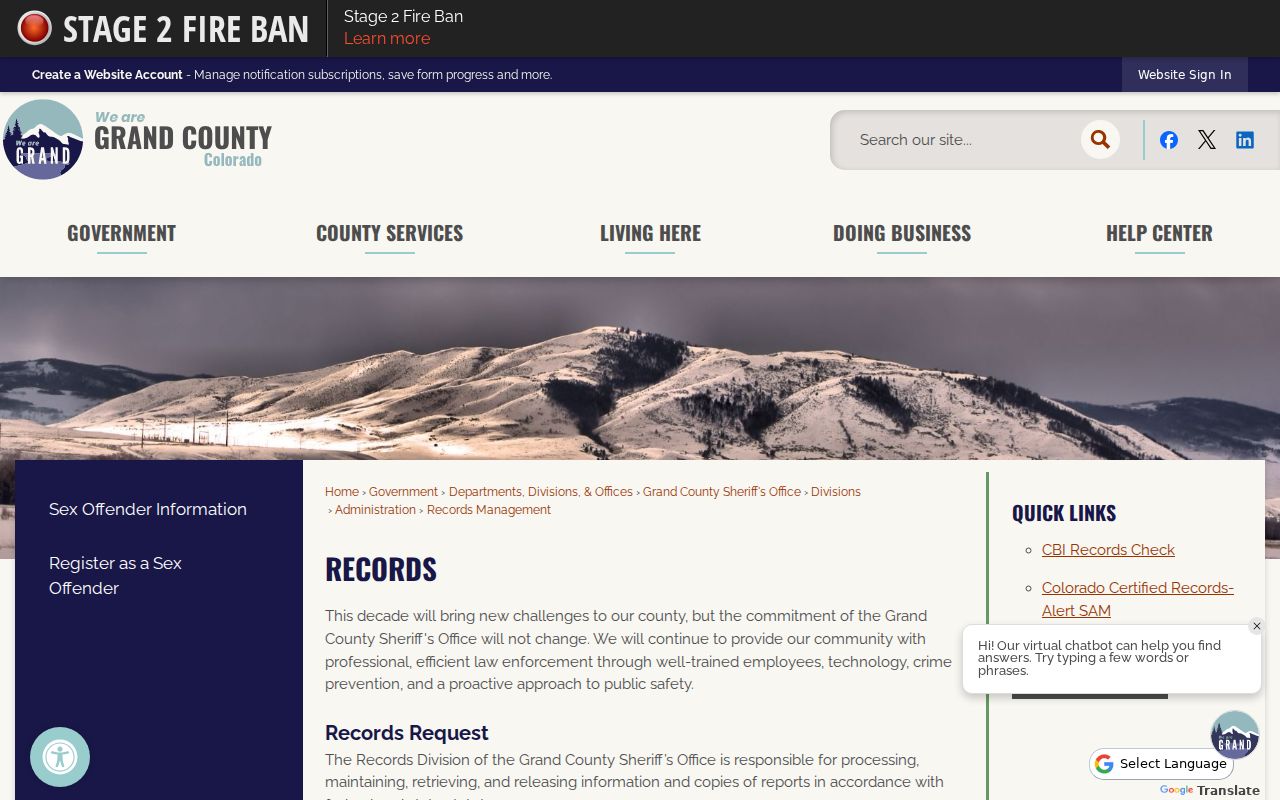
The Sheriff Records Division accepts an online CCJRA request. The form asks for requester contact data, a case number if known, subject name and date of birth, incident details, the records sought, delivery choice, and photo identification. Requests normally take at least three business days. Complex review and redaction can take longer.
The official Sheriff Records page shows the counter instructions.
Published fee pages differ. A legacy page mentions $5 for up to ten printed pages, while the newer form lists labor-based report and media charges. Ask for a quote before authorizing work.
Sheriff Records Division
308 Byers Avenue
Hot Sulphur Springs, CO 80451
970-725-3343
records@co.grand.co.us
Combined Courts
307 Moffat Avenue
Hot Sulphur Springs, CO 80451
970-725-3357
grandclerk@judicial.state.co.us
Colorado Public Access Laws
The Colorado Criminal Justice Records Act, or CCJRA, governs records held by police, sheriffs, prosecutors, and other criminal-justice agencies. Some records are open, while others require a custodian to weigh privacy, safety, investigation needs, and the interests of justice. The Colorado Open Records Act covers other public records. Court access also follows judicial rules and sealing orders.
Key Colorado laws:
C.R.S. §§ 24-72-301 through 309 govern criminal-justice record inspection and release.
C.R.S. §§ 24-72-200.1 through 205.5 govern other state and local public records.
C.R.S. § 24-72-702 provides petition procedures for eligible adult record sealing.
C.R.S. § 19-1-306 addresses expungement of eligible juvenile records.
Grand County Custody Record Layers
County and state custody tools answer different questions. The jail line is the direct path for a person held locally. The CDOC Offender Search covers state correctional custody and certain community-supervision statuses. Probation is run through the state judicial branch by the 14th Judicial District, while parole authority rests with the Colorado State Board of Parole and supervision with CDOC.
The official state locator shows the CDOC search route.
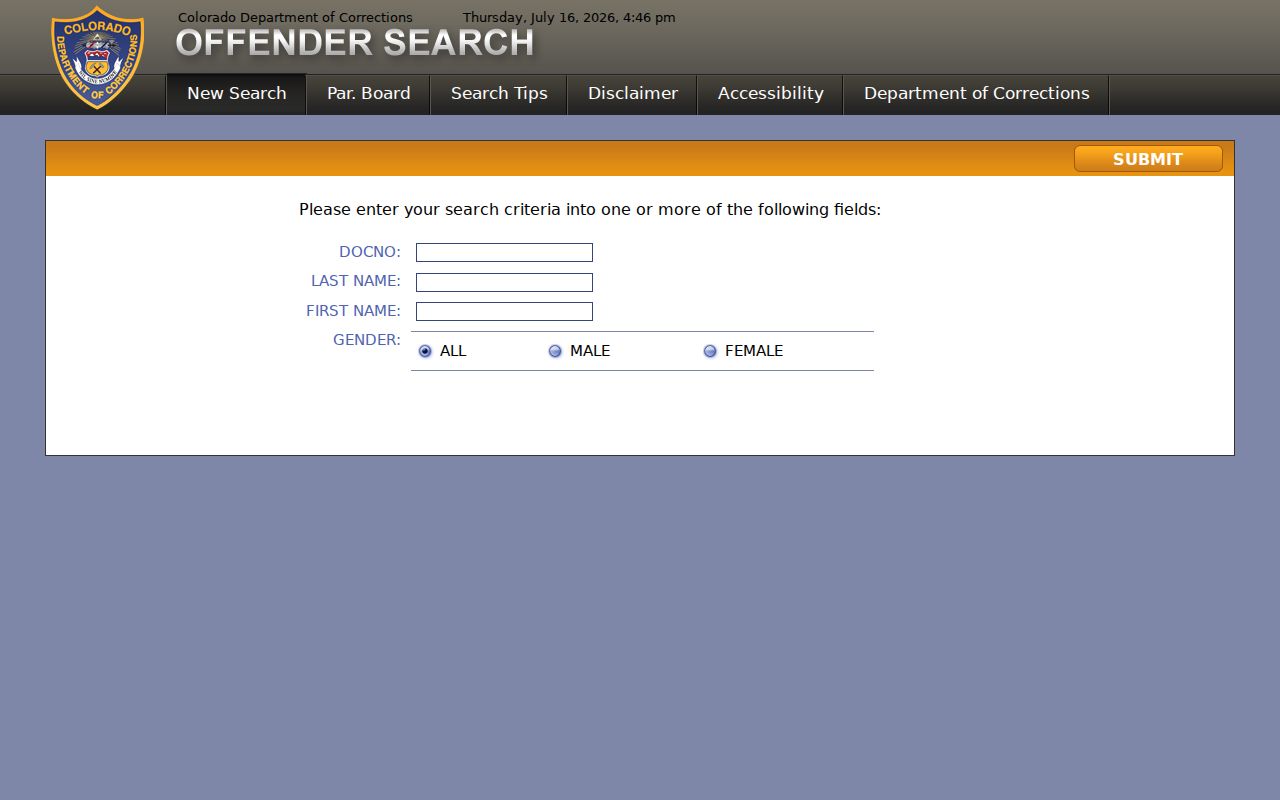
A person absent from CDOC may still be in Grand County Jail, on judicial probation, released, or outside the state system. Check the custodian that fits the status.
Grand County Warrant Record Sources
A warrant can appear in more than one record system, but Grand County does not publish a complete official warrant database in the researched channels. Sheriff Records can address sheriff-held warrant or incident material through the CCJRA form. The non-emergency dispatch line, 970-725-3311, is the direct county contact for a current safety question. A bench warrant issued inside a pending criminal case belongs in the court file, so the Combined Courts clerk is the right source for the judicial entry.
The statewide docket may show a scheduled hearing or case number, yet it is a hearing calendar rather than a warrant check. A person trying to resolve their own possible warrant should call the court or a lawyer before traveling to a counter. Do not treat silence from a web search as proof that no warrant exists. Ask which agency issued it, note the case number, and confirm the present status with that custodian.
A current warrant can lead to arrest. Confirm a possible Grand County warrant with the issuing court or law-enforcement agency.
Restricted, Sealed & Expunged Records
Colorado mainly uses record sealing for adult cases and expungement for juvenile delinquency records. Eligible non-convictions and some convictions may qualify through petition or automatic processes. A public search may then return no result even though restricted information remains available to agencies authorized by law. A pardon is different: it is executive relief and does not by itself erase every record.
The Colorado Judicial Branch offers a subject-only sealed-case confirmation search.
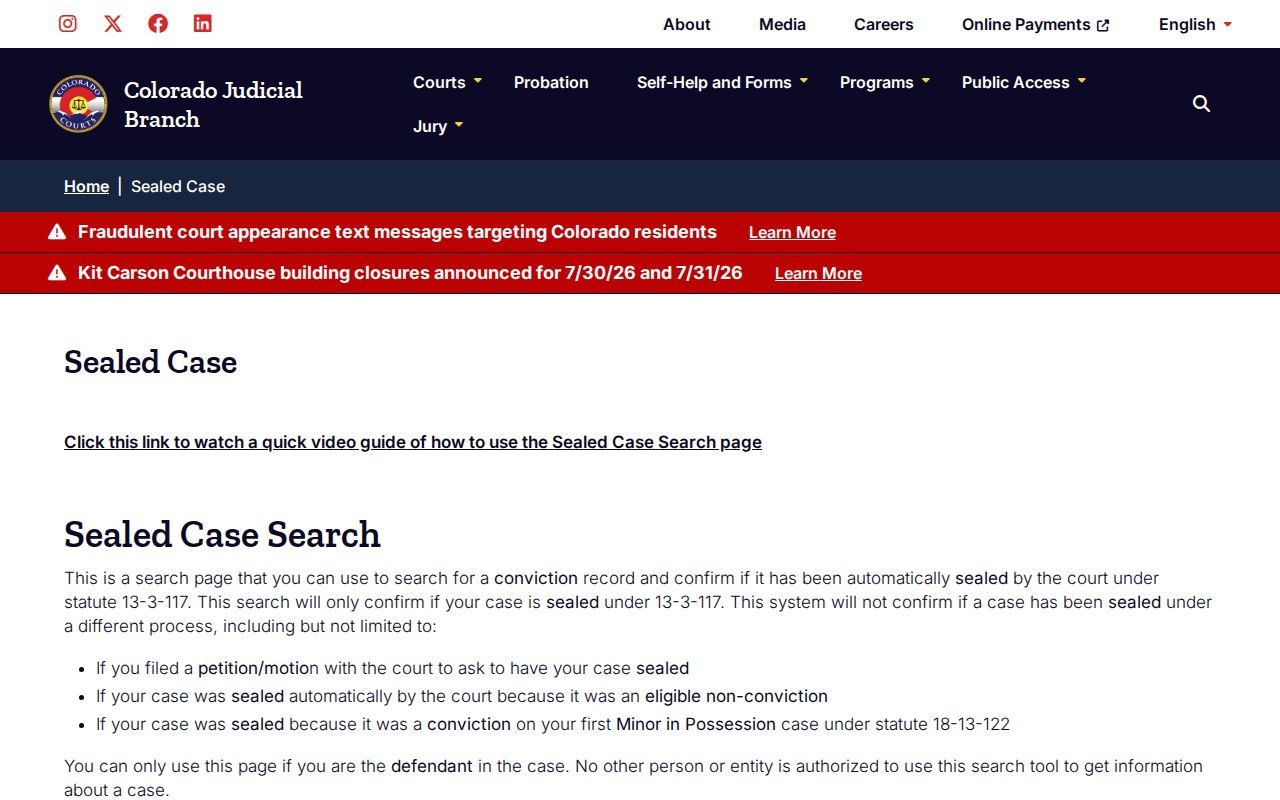
HB24-1432 required CBI to remove its sealing charges by June 30, 2026. Court filing or copy fees remain separate. Confirm the order with the court and later review the CBI record for correct processing.
Grand County Supervision Records
Probation and parole are not the same. The 14th Judicial District Probation Department is part of the Colorado Judicial Branch and serves Grand, Moffat, and Routt Counties. Its Grand County contact is 970-725-3495. Probation terms begin with a court order, so the case register and sentencing entry are the best public sources for the original conditions and length.
Parole follows a state prison term. Decisions rest with the Colorado State Board of Parole, and CDOC's Division of Adult Parole provides community supervision. The public CDOC locator may show a qualifying supervision status, but it does not replace the sentencing file or a direct agency confirmation. When status appears unclear, compare the court sentence, CDOC result, and the office that now supervises the person.
| Status | Authority | Primary record |
|---|---|---|
| Probation | 14th Judicial District | Court sentence and probation office |
| Parole | State Board of Parole and CDOC | CDOC locator and parole record |
Grand County Justice Workload
Grand County's official 2024 operating schedule recorded 18,822 sheriff calls or responses, 1,339 incidents, and 507 arrests. Arrests were down from 560 in 2023 even as calls and incidents rose. Those measures are not interchangeable. Calls are requests or responses, incidents are agency events, and arrests are custody actions. None of them is a conviction count.
The Colorado crime-data program provides the statewide reporting context.
Use these figures to understand workload, not to judge a person or infer an outcome. Court dispositions remain the source for case results.
City-by-City Criminal Records in Grand County
Granby, Kremmling, and Fraser are the county's three largest incorporated places by the 2020 Census. Their local police and municipal courts create records that do not begin at the county courthouse. A city report stays with its police custodian, a county booking goes to the sheriff, and a state criminal case goes to Grand County Combined Courts. Each city route reflects that split.
Granby Record Check
2,079 · Granby Police reports and a town court of record.
Kremmling Record Check
1,509 · Town records plus county booking and state court layers.
Fraser Record Check
1,400 · Shared Fraser Winter Park police and municipal court.