
Criminal Court Cases in Grand County
Grand County belongs to Colorado's 14th Judicial District. The Grand County District Court hears felonies and other district criminal proceedings. Grand County Court handles misdemeanors, traffic cases, advisements, and preliminary matters assigned to it. Both operate as Grand County Combined Courts at 307 Moffat Avenue in Hot Sulphur Springs. The shared clerk can be reached at 970-725-3357 or grandclerk@judicial.state.co.us, and the published counter hours are Monday through Friday, 8 a.m. to 5 p.m.
Municipal cases follow a different track. Granby Municipal Court keeps town traffic, parking, animal, and ordinance cases. Fraser and Winter Park use a joint municipal court, while Kremmling handles its own town matters. A municipal citation may never become a Grand County state case. The elected Grand County Clerk and Recorder also is not the criminal-court clerk. That office handles land, motor vehicle, election, and other county records.
The official Combined Courts page shows the local filing and clerk channels.
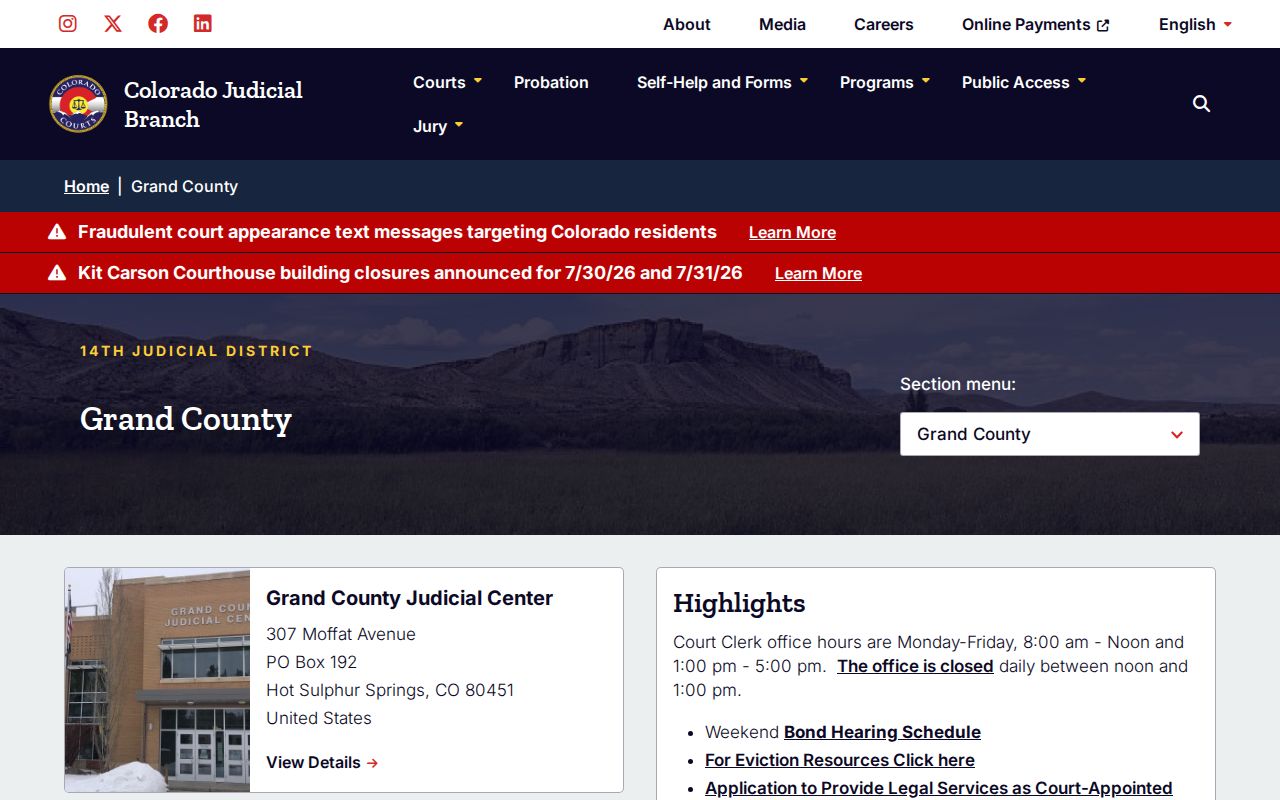
That page is the best current source for clerk contact details, filing instructions, accommodations, and local docket links.
Grand County Court Levels Compared
The charge and court level decide where to look. A felony file belongs in District Court. A county misdemeanor normally belongs in County Court. Town ordinance and eligible municipal traffic or petty matters remain with the proper municipal clerk. This split matters because one name search may show a state hearing but omit a separate town case.
| Court | Typical criminal jurisdiction | Record channel |
|---|---|---|
| Grand County District Court | Felonies and district criminal proceedings | Combined Courts clerk |
| Grand County Court | Misdemeanors, traffic, advisements, preliminary matters | Combined Courts clerk |
| Granby Municipal Court | Town traffic, parking, animal, and ordinance cases | Granby municipal clerk |
| Fraser/Winter Park Municipal Court | Joint town municipal matters | Joint municipal clerk |
| Kremmling Municipal Court | Town ordinance and municipal matters | Town Hall or municipal clerk |
The 14th Judicial District Attorney prosecutes state charges in Grand, Moffat, and Routt Counties. It does not keep the court's official case file. The District Attorney's official site provides office and victim-service information.
The prosecutor's page can explain the office's role, but document and disposition requests still go to the court clerk.
Grand County Case Record Searches
The Colorado Judicial Branch Docket Search is the fastest free starting point. It is a hearing calendar, not a full case database. It can reveal a case number, party name, hearing type, date, time, expected length, courtroom, and whether an appearance is virtual, by telephone, or in person. At least one filter beyond the date is required.
- Open the Colorado docket and select Grand County or the 14th Judicial District.
- Enter a case number when known, or use the party-name fields with a date range.
- Compare court, year, case class, and hearing details before attributing the result.
- Use the case number to request the register of action and selected documents.
- Ask the municipal clerk separately if the matter arose under a town code.
| Field label | Type | Required | Use |
|---|---|---|---|
| Judicial District / County | Dropdown | No | Select the 14th district and Grand County |
| Date Range | Dropdown | Default | Controls the hearing window |
| Case Number | Year, class, sequence | No | Best precise identifier |
| First / Last Name | Text | No | Searches individual parties |
| Courthouse / Court Type | Dropdown | No | Narrows the venue |
| Attorney / Bar Number | Text | No | Finds counsel-linked calendar entries |
The Grand County filtered docket demonstrates those controls and the resulting hearing entries.
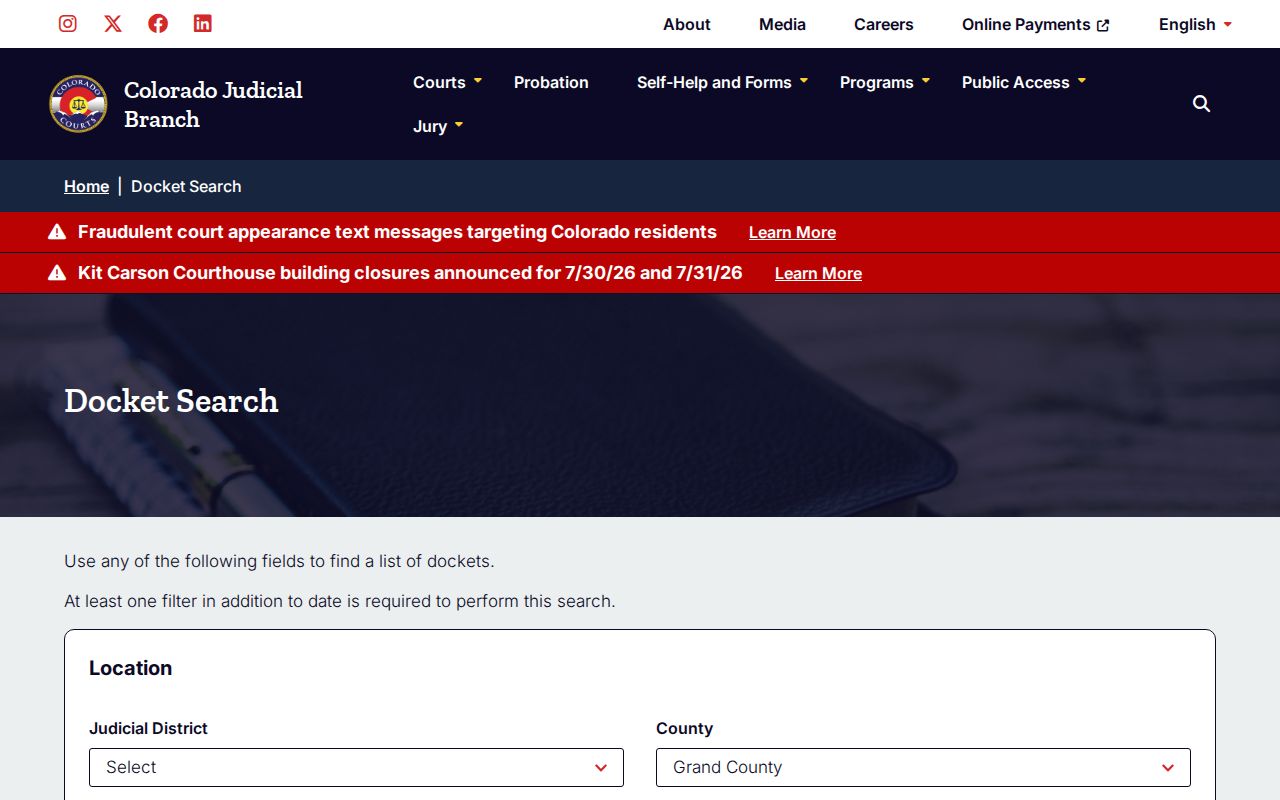
Use its result as a lead to the file, not as proof of a charge, conviction, or sentence.
Decode Grand County Case Numbers
Grand County docket entries combine a filing year, a case class, and a sequence number. Formats observed in the official calendar include 2026CR30, 2026M92, and 2026T165. The code CR identifies a district criminal case. M marks a county misdemeanor case, and T marks traffic. The record request form also lists JD for juvenile delinquency and R among criminal matters, but juvenile access is restricted.
- Advisement
- The first appearance when rights, allegations, and release terms are addressed.
- Preliminary Demand
- A local docket label tied to the preliminary-hearing stage in an eligible case.
- Appearance on Bond
- A hearing entry concerning release status or bond conditions.
- Pretrial Conference
- A court event used to address readiness, motions, negotiations, or scheduling before trial.
- Disposition
- The outcome of a case or charge, such as conviction, acquittal, dismissal, or deferred resolution.
A class code does not disclose the full charge. It also does not show the felony or misdemeanor level by itself. Read the complaint or information and the register of action before drawing a conclusion.
What a Criminal Case File Contains
A full Grand County court file answers questions the public calendar cannot. The register of action provides a brief chronology of charges, sentences, and court events. The charging document shows what the prosecutor filed, which may differ from the allegation at booking. Motions, orders, plea entries, bond actions, judgments, and financial records add the detail needed to understand what occurred.
| Case number and court | Identifies the filing year, case class, sequence, and court responsible for the file. |
|---|---|
| Complaint or information | States the prosecutor-filed charges and cited law. |
| Register of action | Summarizes filings, hearings, orders, charges, disposition, and sentence. |
| Hearing entries | Show scheduled and completed events, appearance modes, and divisions. |
| Disposition or judgment | Records the outcome for the case or individual charges. |
| Sentence and conditions | May identify confinement, probation, restitution, fines, fees, and other orders. |
Protected addresses, birth dates, financial identifiers, victim information, and juvenile material may be redacted or withheld. A register is often enough for a self-audit, but a certified order may be needed to document an outcome to another official agency.
Order Grand County Court Records
The Grand County clerk accepts requests for a register of action, complaint or information, disposition or sentence order, protection order, and ticket. The form asks for the court location, case number, party names, chosen documents, certification, delivery method, and requester contact and payment details. A narrow request with a known number usually avoids needless search time.
| Published item | Fee |
|---|---|
| Non-party search with register of action | $5 |
| Research or redaction after first hour | $30 per hour |
| Offsite retrieval | $5 |
| Paper copy | $0.25 per page |
| Photographic copy | $0.75 each |
| Certification or exemplification | $20 per document, plus copies |
Postage also follows published tiers. Confirm the current quote before paying because statewide fiscal rules can change. Older or non-indexed files may require offsite retrieval.
The Colorado Judicial Branch fee list supplies the current statewide schedule.
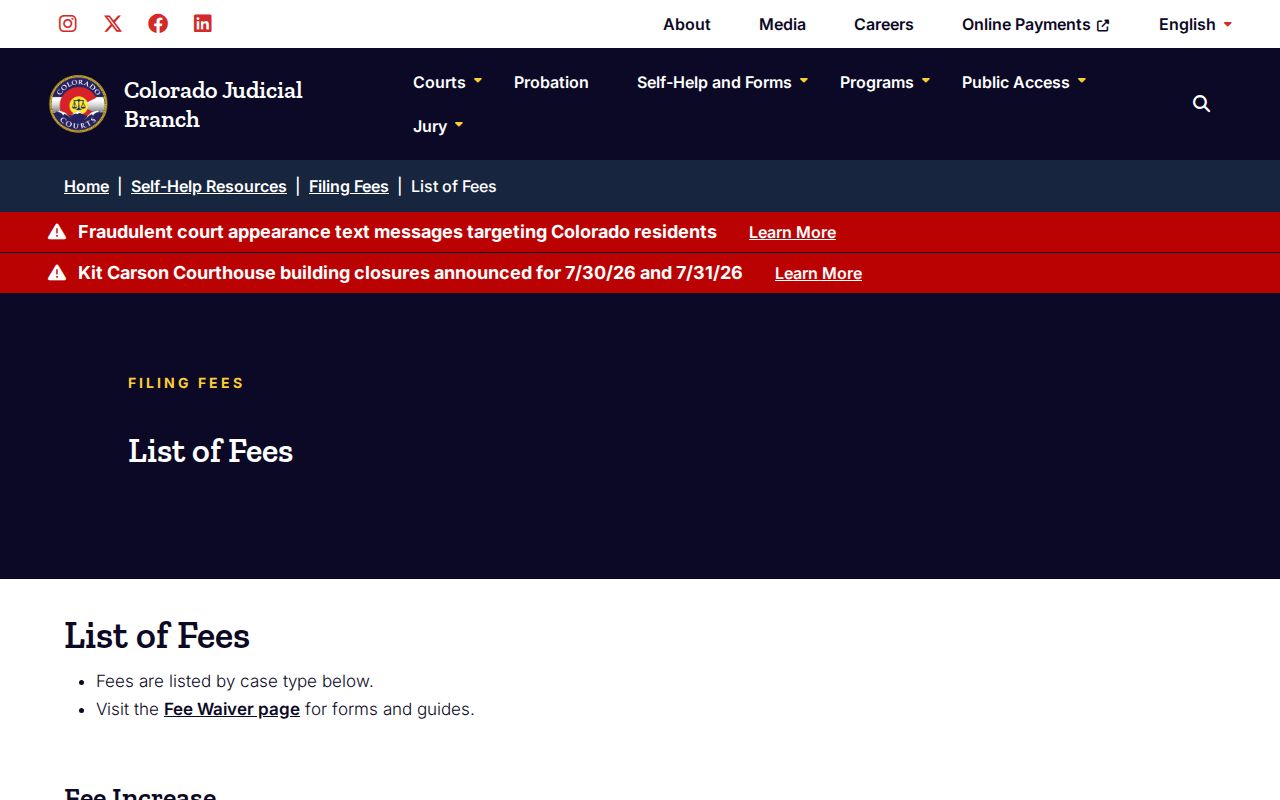
The live fee page should control whenever an older form, saved copy, or informal summary conflicts with it.
Criminal Case Stages in Grand County
A Grand County case may begin with arrest or summons, but the court record starts as prosecutors and judicial officers act. Advisement addresses rights, allegations, and release. A complaint, information, or indictment sets out the filed charge. Eligible felony matters may include a preliminary hearing. Arraignment calls for a plea, and motions or pretrial conferences shape what happens next.
Case flow: Charges Filed › Arraignment › Pretrial › Plea or Trial › Disposition › Sentencing
A plea or trial produces a disposition. Sentencing follows a conviction when required. An appeal or a later probation-revocation event can add new entries. Calendar labels such as Return on Summons for Revocation of Probation describe an event, not its result. Obtain the register before assuming whether the court continued, changed, or revoked probation.
Read Grand County Appearance Types
The local docket has shown VIRTUAL, TELEPHONE, and IN PERSON appearance types. It also supplies a start time, estimated length, courtroom or division, and hearing label. Those details help a party identify the scheduled event. They do not grant permission to appear in a different way. Follow the filed notice or clerk's instruction for the specific case.
The court offers virtual appearances in many docket entries and a Webex route for scheduled self-help appointments. The official page also points to a Spanish docket interface and judicial language-access resources. Request needed help in advance because the published information does not promise a specific interpreter without coordination.
Access Rules for Case Records
Colorado Chief Justice Directive 05-01 governs public access to judicial records. Court access remains subject to sealing orders, juvenile confidentiality, protected victim data, and required redactions. A public request cannot override those limits. Common-name results also are not proof of identity, so compare the full name, time period, court, and any lawfully available identifying detail.
If a Grand County case does not appear, ask the clerk whether the issue is the date range, an old or offsite file, a municipal venue, or a restricted record. The Colorado Judicial Docket Search is only a calendar and may not show a closed case with no scheduled hearing. The clerk's register is the better source for the filed charges and outcome.
CBI's name-based criminal history serves a different purpose. It compiles available statewide arrest cycles and reported dispositions, but it can lag or summarize a court result. For review of one's own history, compare the CBI entry against the Grand County disposition and seek correction through the custodian that owns the inaccurate part.
Grand County Court Roles Differ
The clerk, prosecutor, and defense lawyer have distinct jobs. The clerk holds the official court file and supplies permitted copies. The 14th Judicial District Attorney chooses and prosecutes state charges, offers victim services, and does not serve as a public court-record desk. Colorado's state public defender represents qualifying accused people after appointment and does not operate a public case lookup.
The Colorado State Public Defender site explains the defense system and office-finder route.
Grand County's published public-defender contact is 970-879-0645. Questions about representation belong there, while copies and docket records remain with Combined Courts.